
If you are working through your TC2 TMI2 qualification, you already know that the classroom component is only part of what is required. The practical assessment is where the real work happens, and for many candidates, the three TMI2 practical set-ups are the part of the qualification that feels most uncertain going in. Understanding exactly what these set-ups involve, what assessors are looking for, and how to approach each one confidently makes a significant difference to how smoothly the assessment goes.
This guide explains what the three TMI2 practical set-ups are, what each one tests, and what you need to do to pass them.
What Are the TMI2 Practical Set-Ups?
The three practical set-ups are the on-site assessment component of the tc2 tmi2 course in adelaide. They are separate from the classroom training and are conducted in real Category 2 high volume road environments rather than simulated settings. This is deliberate. The TMI2 qualification certifies you to implement traffic management on the most demanding road environments in the framework, and the practical assessment needs to reflect the conditions you will actually be working in.
Each set-up involves you, as the candidate, demonstrating your ability to implement a specific type of Traffic Guidance Scheme in accordance with an approved Traffic Management Plan. An assessor observes your performance across the full set-up process, from preparation and briefing through to implementation, monitoring, and close-down. Three separate set-ups are required rather than one because the qualification needs to demonstrate competency across a range of Category 2 scenarios, not just proficiency in a single configuration.
What Each Set-Up Actually Involves
While the specific scenarios used in your practical assessment will depend on the sites and conditions available at the time of your assessment, the three set-ups are designed to cover distinct types of Category 2 traffic management situations that reflect the range of environments TMI2-certified workers are qualified to manage.
- Set-Up One typically covers a multi-lane or dual carriageway configuration. Category 2 roads frequently involve multiple lanes in each direction, and managing a work zone on this type of road requires an understanding of how to configure lane closures, merge tapers, and delineation arrangements that safely direct traffic through the changed environment. This set-up tests your ability to interpret the approved Traffic Management Plan for a multi-lane environment and implement the Traffic Guidance Scheme correctly across a wider and more complex road cross-section than a Category 1 scenario would involve.
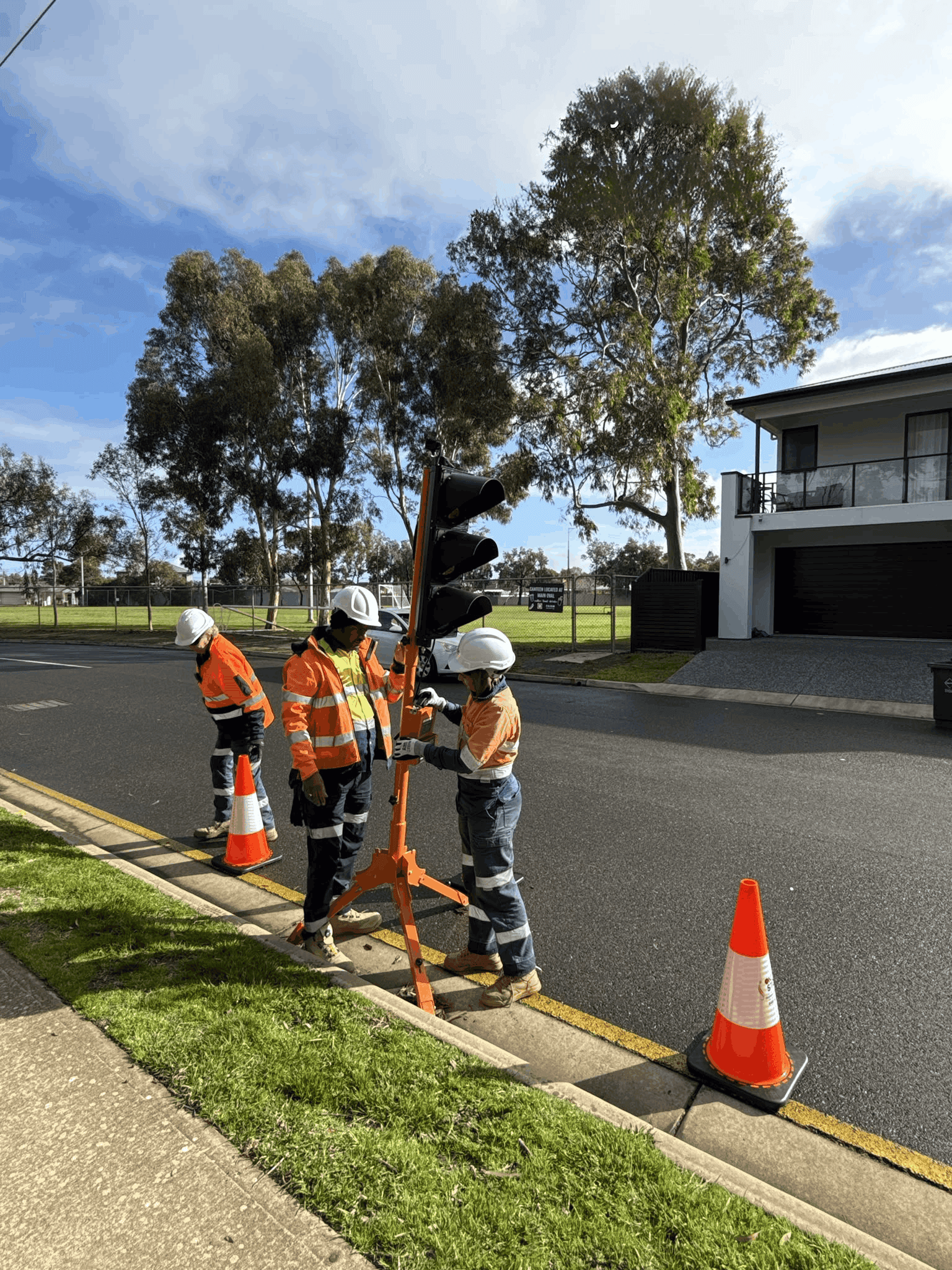
- Set-Up Two typically covers a signalised intersection or approach to a signalised environment. This is one of the most technically specific requirements of the TMI2 qualification and one that most candidates have not encountered in their Category 1 work. Managing traffic in proximity to traffic signals requires an understanding of how your traffic management arrangements interact with signal phasing, how to coordinate with the road authority's signals team where modifications to signal timing are required, and how to position controllers and delineation in a way that does not create conflicts with the existing signal-controlled movements through the intersection.
- Set-Up Three typically covers a scenario involving elevated risk conditions such as night works, high-speed rural environment, or complex pedestrian management on a high-volume road. This set-up tests your ability to apply the enhanced safety requirements that these conditions demand, including extended advance warning distances for high-speed environments, enhanced lighting and retroreflective provisions for night works, and the specific pedestrian separation requirements that apply when a high-volume road has significant pedestrian movement adjacent to the work zone.
What Assessors Are Looking For
Understanding the assessment criteria helps you approach each set-up with the right focus. Assessors are not looking for perfection under pressure. They are looking for evidence that you understand what you are implementing, why each element of the Traffic Guidance Scheme is positioned the way it is, and how to manage the set-up safely from start to finish.
- Preparation and briefing. Before any physical set-up begins, you should demonstrate that you have read and understood the approved Traffic Management Plan for the scenario, that you know what the Traffic Guidance Scheme requires, and that you have briefed the controllers involved in the set-up on their positions and responsibilities. This preparation phase is assessed as carefully as the physical implementation.
- Correct implementation of the Traffic Guidance Scheme. Device placement, sign positioning, taper dimensions, and barrier configurations all need to reflect what the approved plan requires. Advance warning sign distances need to be appropriate for the speed environment. The sequence of implementation needs to follow the approved procedure.
- Communication and coordination. Category 2 set-ups involve coordinating multiple controllers and in some cases communicating with the road authority or adjacent worksites. Your ability to communicate clearly, give precise instructions, and manage the set-up as a coordinated operation rather than a series of individual tasks is a specific assessment focus.
- Monitoring and adaptation. Once the set-up is in place, your assessor will observe how you monitor its performance. Do you identify when something is not working as it should? Do you respond appropriately to changes in site conditions? Can you adapt the arrangement within the scope of the approved plan without creating a compliance gap?
- Close-down. The set-up close-down is as important as the installation. Removing a Traffic Guidance Scheme in the wrong sequence can expose workers to live traffic during the removal process. The correct sequence for removing each element of the set-up, and the coordination required to do so safely, is part of what the assessment covers.
How to Prepare for Each Set-Up
The most effective preparation for the TMI2 practical set-ups is genuine on-site experience in Category 2 environments before you sit the assessment. The entry requirements for the traffic management category 2 certification in Adelaide specifically require candidates to have completed 40 hours of traffic controller experience and one month of TMI1 application in a workplace setting. These requirements exist because the set-ups are designed to assess skills that have been developed through real practice, not skills that are being performed for the first time on assessment day.
Beyond experience, specific preparation for the assessment should include reviewing the Traffic Guidance Schemes relevant to the three scenario types described above, confirming your understanding of advance warning distance requirements for Category 2 speed environments, and practising the briefing and communication processes that the assessment requires.
Work closely with your employer to ensure that the on-site experience you are building in the lead-up to your assessment includes exposure to all three scenario types where possible. A candidate who has physically set up a multi-lane closure, worked near a signalised intersection, and managed a night shift on a high-volume road before sitting the assessment will approach each set-up with the procedural memory and situational awareness that makes the difference between a competent and an uncertain performance.
What Happens If You Do Not Pass a Set-Up?
If your performance on one of the set-ups does not meet the assessment standard, your assessor will provide specific feedback on what was not demonstrated to the required level. In most cases, a re-assessment of the specific set-up can be arranged once you have addressed the identified gaps through additional practice or targeted preparation.
A set-up result that requires re-assessment is not a reason to be discouraged. The assessment is designed to confirm genuine competency rather than to create a pass rate that limits progression. If something specific was not demonstrated to standard, understanding precisely what it was and addressing it directly is a straightforward path to a successful re-assessment.
The Bigger Picture
The three TMI2 practical set-ups are the culmination of everything covered in the traffic control training in Adelaide at TC2 TMI2 level. They represent the transition from classroom knowledge to demonstrated, assessed competency in real Category 2 environments. Approaching them with genuine preparation, honest reflection on your current experience level, and a clear understanding of what each scenario requires is what gives you the best chance of completing all three to the standard required and earning the qualification that opens access to the most demanding and most rewarding roles in South Australian traffic management.