One of the most common questions people ask before booking a CPR course is whether they need any prior experience or background in first aid to participate. It is an understandable concern. CPR sounds technical, and many people assume there must be some baseline knowledge required before you can walk through the door and start learning.
The answer is straightforward: no, you do not need any prior first aid experience to enrol in a CPR course in Adelaide. The course is specifically designed for people who have never performed CPR before, and the training methodology reflects that. If you are a complete beginner, you are exactly the kind of person this training is built for.
This guide explains what you can expect as a first-timer, why the course is accessible regardless of background, and who typically shows up to CPR training in Adelaide.
Who CPR Training Is Designed For
CPR training is not a medical course. It is not designed for nurses, paramedics, or people with clinical backgrounds. It is designed for everyday people who want the skill and confidence to respond if someone near them stops breathing or their heart stops.
The people who attend CPR training in Adelaide come from every walk of life. Construction workers, retail staff, office administrators, parents, grandparents, teachers, hospitality workers, and trade professionals all sit in the same room and learn the same skills. None of them are expected to arrive knowing anything. The entire point of the course is to give people who know nothing a practical, usable skill they can carry with them for the rest of their lives.
If you have never taken a first aid course, never worked in healthcare, and have no background in emergency response whatsoever, you are not behind. You are the target audience.
What the Course Covers From the Ground Up
The CPR course delivered as HLTAID009 Provide Cardiopulmonary Resuscitation starts at the very beginning. There is no assumed knowledge, no jargon that goes unexplained, and no expectation that participants arrive with anything more than a willingness to learn.
The course begins with an overview of the DRSABCD action plan, which is the structured approach to assessing and responding to an emergency situation. DRSABCD stands for Danger, Response, Send for help, Airway, Breathing, CPR, and Defibrillation. Your trainer will walk through each step clearly, explaining what you are looking for, what decisions you are making, and what actions you are taking at each stage.
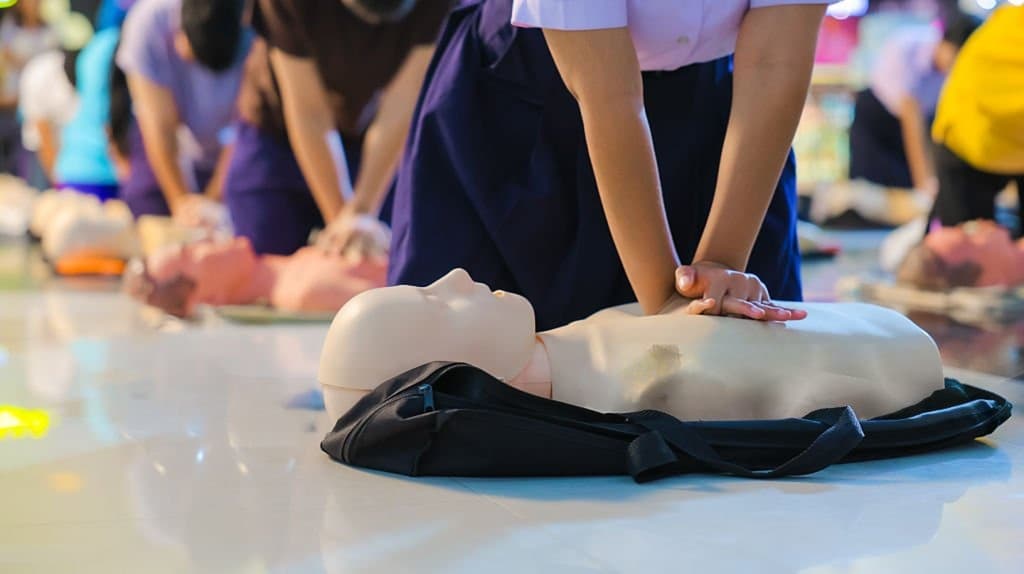
From there, the course moves into hands-on practical training using CPR manikins. You will learn the correct technique for chest compressions, including hand placement, compression depth, rate, and rhythm. You will practise rescue breaths and learn when and how to apply them. You will learn how to operate an Automated External Defibrillator, which is the device commonly found in public places like shopping centres, gyms, and workplaces that can restore a normal heart rhythm during a cardiac arrest.
The ratio of theory to practical is deliberately weighted toward the practical because CPR is a physical skill. Reading about it is useful but doing it is what builds the confidence to actually use it in an emergency. Your trainer will watch you practise, correct your technique where needed, and ensure you leave the course with a skill you can genuinely rely on.
The Assessment Is Straightforward
At the end of the course, participants complete a practical assessment and a short written component. Neither of these is designed to catch people out. The assessment confirms that you can perform CPR correctly and that you understand the key steps of the DRSABCD action plan.
If you have engaged with the course content and practised during the session, the assessment should feel like a natural extension of what you have already been doing rather than a separate high-pressure test. Trainers are there to support you through the process, and most people pass on their first attempt.
If you find any part of the assessment challenging, your trainer can provide additional guidance and the opportunity to demonstrate your competency before the session concludes.
How Long Does the Course Take?
The HLTAID009 CPR course is one of the shorter nationally recognised certifications available. Most sessions are completed in approximately two to three hours, making it one of the most time-efficient ways to acquire a genuinely important life skill.
For people with busy schedules, including workers who need to fit certification around shift work, construction projects, or other training commitments, this compact timeframe is a significant practical advantage. You can complete your CPR training in a single morning or afternoon without it significantly disrupting your week.
Who Typically Attends CPR Training in Adelaide
The mix of people who turn up to a CPR course in Adelaide reflects just how broadly this skill is valued. Construction workers completing certification alongside their White Card or traffic management qualifications are a common presence. Many workers in the construction and civil infrastructure sector pursue CPR training as part of a broader compliance portfolio, sometimes completing it on the same day or in the same week as their traffic control training in Adelaide to consolidate their certification requirements efficiently.
Workplace groups are another common format, with employers booking sessions for teams of staff who need current CPR certification to meet workplace health and safety obligations. In these sessions, colleagues who have never discussed first aid before are often surprised by how accessible the training turns out to be.
Parents, carers, sporting coaches, and community volunteers make up another significant portion of course participants, motivated by the desire to be prepared in everyday environments rather than just for professional compliance.
What You Need to Bring
There are no prerequisites to bring to a CPR course and no advance study required. What you do need is comfortable clothing that allows you to kneel on the floor comfortably, since CPR practice involves performing compressions at ground level. Closed-toe shoes are also recommended.
If you have any physical limitations that might affect your ability to perform chest compressions, it is worth mentioning this to your training provider when you book. Most trainers are experienced in accommodating participants with physical considerations and can discuss alternative approaches where needed.
Final Thoughts
CPR training is genuinely one of the most accessible skill-building courses available to adults in Australia. No background, no prerequisites, no prior experience required. Just a few hours of focused, practical training that could one day give you the ability to keep someone alive until emergency services arrive.
Whether you are booking as part of a professional compliance requirement, because your employer has asked you to, or simply because you want to feel more prepared in everyday situations, your lack of first aid experience is not a barrier. The CPR course in Adelaide is built for exactly where you are right now.