
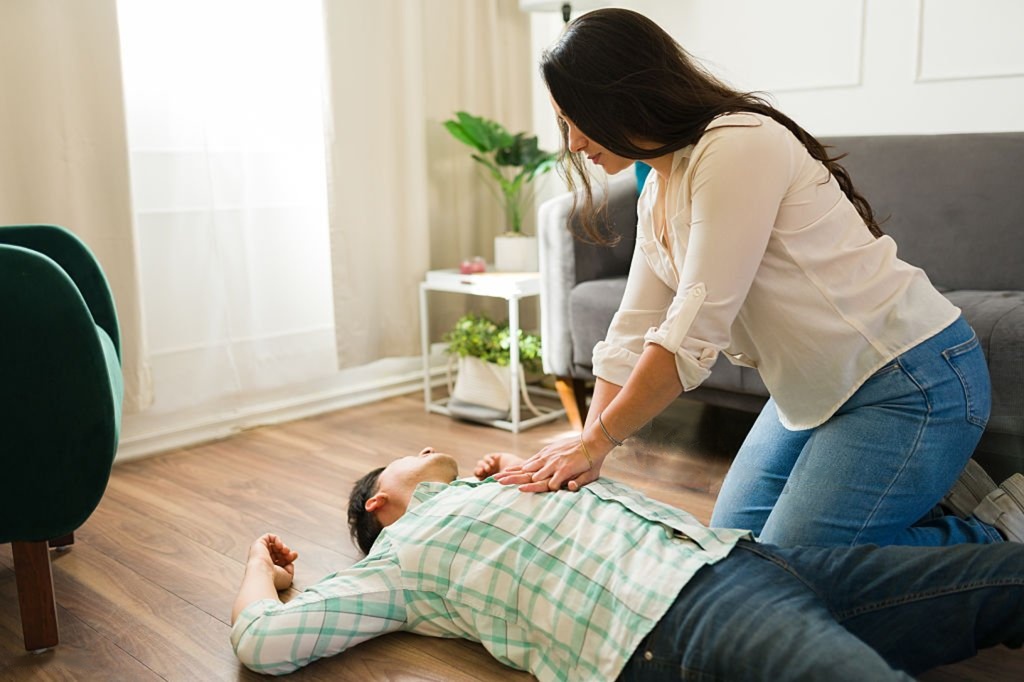
Cardiac arrest can happen anywhere — at home, on a worksite, in a shopping centre, or on a sporting field. In those first critical minutes, what you do (or don’t do) can mean the difference between life and death. Bystander CPR can double or even triple a person’s chance of survival, yet many Australians freeze in the moment simply because they’ve never been trained.
This step-by-step guide walks you through exactly what to do when someone goes into cardiac arrest — and why completing a CPR course in Adelaide is the single most important thing you can do to be prepared.
What Is Cardiac Arrest?
Cardiac arrest occurs when the heart suddenly stops pumping blood effectively. Unlike a heart attack — which is caused by a blocked artery — cardiac arrest is an electrical malfunction that causes the heart to stop beating altogether. The person will collapse suddenly, become unresponsive, and stop breathing normally.
Without immediate action, brain damage can begin within just 4 minutes. That’s why knowing how to respond before an ambulance arrives is absolutely critical.
The DRSABCD Action Plan — Australia’s Standard Emergency Response
In Australia, the recognised framework for responding to any emergency — including cardiac arrest — is the DRSABCD action plan. Here’s how to follow it, step by step.
Step 1: D — Check for DANGER
Before you rush in, scan the scene for hazards — traffic, electrical wires, fire, unstable structures, or anything that could put you or others at risk. You cannot help the casualty if you become one yourself.
✅ Make the area safe before approaching.
Step 2: R — Check for RESPONSE
Kneel beside the person and firmly tap their shoulders. Speak loudly and clearly: “Can you hear me? Are you okay?”
If there is no response, they are unresponsive and you need to act immediately.
✅ If no response — proceed to the next step without delay.
Step 3: S — SEND for Help
Call 000 immediately — or ask a bystander to call while you begin the response. Tell the operator:
- Your exact location
- That someone is unresponsive and not breathing normally
- That you are starting CPR
The 000 operator can also guide you through CPR over the phone if needed.
✅ Never leave the person alone to make the call — delegate it if possible.
Step 4: A — Open the AIRWAY
Gently tilt the person’s head back and lift their chin to open the airway. This moves the tongue away from the back of the throat.
Look inside the mouth for any visible obstruction. If you can clearly see something, remove it carefully. Do not perform a blind finger sweep.
✅ A clear, open airway is essential before you check for breathing.
Step 5: B — Check for BREATHING
With the airway open, look, listen, and feel for normal breathing for no more than 10 seconds:
- Look for chest rise and fall
- Listen for breath sounds
- Feel for air on your cheek
Occasional gasping (agonal breathing) is not normal breathing — treat it as cardiac arrest and proceed.
✅ If not breathing normally — start CPR immediately.
Step 6: C — Begin CPR (Cardiopulmonary Resuscitation)
This is the most critical step. CPR keeps oxygenated blood circulating to the brain and vital organs until the heart can be restarted.
How to perform CPR on an adult:
- Place the heel of one hand on the centre of the chest (lower half of the breastbone)
- Place your other hand on top and interlock your fingers
- Keep your arms straight and compress the chest 5–6 cm deep
- Deliver 30 compressions at a rate of 100–120 per minute (think: the beat of Stayin’ Alive by the Bee Gees)
- After 30 compressions, give 2 rescue breaths — tilt the head, pinch the nose, seal your lips over their mouth, and breathe until you see the chest rise
- Continue the cycle of 30 compressions : 2 breaths
Compression-only CPR: If you are untrained or uncomfortable giving rescue breaths, continuous chest compressions alone are far better than doing nothing. The 000 operator can guide you.
✅ Do not stop CPR until the person starts breathing normally, an AED is ready to use, paramedics take over, or you are physically unable to continue.
Step 7: D — DEFIBRILLATION with an AED
An Automated External Defibrillator (AED) delivers an electric shock to the heart to restore a normal rhythm. AEDs are now found in many public places — shopping centres, gyms, workplaces, airports, and community facilities.
How to use an AED:
- Turn it on — most models guide you with voice prompts
- Attach the pads to the person’s bare chest as shown in the diagrams
- Make sure no one is touching the person when the AED analyses the rhythm
- If a shock is advised, press the button when instructed and stand clear
- Resume CPR immediately after the shock — do not wait to see if it worked
✅ AEDs are designed for untrained bystanders — follow the voice prompts and don’t be afraid to use one.
Special Considerations
CPR on Children and Infants
The technique varies slightly for younger casualties:
- Children (1–8 years): Use one or two hands depending on the child’s size; compress to one-third of the chest depth; use gentle rescue breaths
- Infants (under 1 year): Use two fingers on the centre of the chest; cover both the mouth and nose with your mouth for rescue breaths
These techniques are covered in detail during CPR training in Adelaide — particularly important for parents, grandparents, childcare workers, and educators.
CPR in the Workplace
Under South Australian workplace health and safety obligations, many industries require staff to hold current CPR certification. These include:
- Construction and civil works
- Traffic management and road crews
- Aged care and disability support
- Childcare and education
- Fitness and recreation
- Hospitality and events
If you work in any of these sectors — or manage a team that does — ensuring your staff are certified in CPR training in Adelaide is not just good practice, it’s often a legal requirement.
Why Hands-On CPR Training Matters
Reading a guide like this is a great starting point — but it is no substitute for real, hands-on practice. Research consistently shows that people who have practised chest compressions on a manikin respond faster, more accurately, and with far greater confidence in a real emergency.
In a CPR course in Adelaide, you’ll practise:
- Correct hand placement and compression technique
- Rescue breathing with immediate instructor feedback
- Realistic emergency scenarios under simulated pressure
- Safe and effective use of an AED
At One Stop Training Solutions in Royal Park, our HLTAID009 CPR course is delivered face-to-face in small groups, so every participant receives individual coaching and leaves genuinely prepared to act.
How Often Should You Renew Your CPR Certification?
According to the Australian Resuscitation Council (ARC), CPR skills should be renewed every 12 months. Skills fade quickly — studies show that compression quality declines significantly within just a few months of initial training.
If your HLTAID009 certification has lapsed, or you’re due for your annual refresher, our Adelaide CPR course gets you re-certified quickly and efficiently.
Be Ready Before You Need to Be
Cardiac arrest doesn’t give you a warning. It doesn’t happen at a convenient time or place. But with the right training, you can walk into any situation with the knowledge and confidence to act — and potentially save a life.
Whether you need certification for work, compliance, or simply your own peace of mind, our CPR course in Adelaide is the practical, nationally recognised training you need.
🏗️ Also looking for traffic management training? One Stop Training Solutions also delivers traffic control training in Adelaide, including TC1/TMI1 and TC2/TMI2 courses — all run from our Royal Park training facility.
Enrol in a CPR Course at One Stop Training Solutions
📍 56 Tapleys Hill Road, Royal Park SA 5014 📞 08 7112 0741 | +61 480 623 654 🌐
HLTAID009 — Provide Cardiopulmonary Resuscitation Nationally recognised | ARC-aligned | Face-to-face | Small groups
👉 Enrol online today and be ready when it matters most.
One Stop Training Solutions is an approved RTO delivering nationally recognised first aid, CPR, and traffic management training across Adelaide and South Australia.